


Women's Fitness Medicine
Helping women build strength, confidence and better health.
Women's Fitness Medicine
Women's health is perhaps the most important yet most neglected in a family's healthcare. Indian women take their ‘nurturer’ role very seriously and contribute immensely to the welfare of their families but mostly fail to take care of themselves. SPARRC’s Women’s Fitness Medicine focuses on making women understand the significance of their health and equips them with a simple and sustainable fitness routine and nutrition profile.
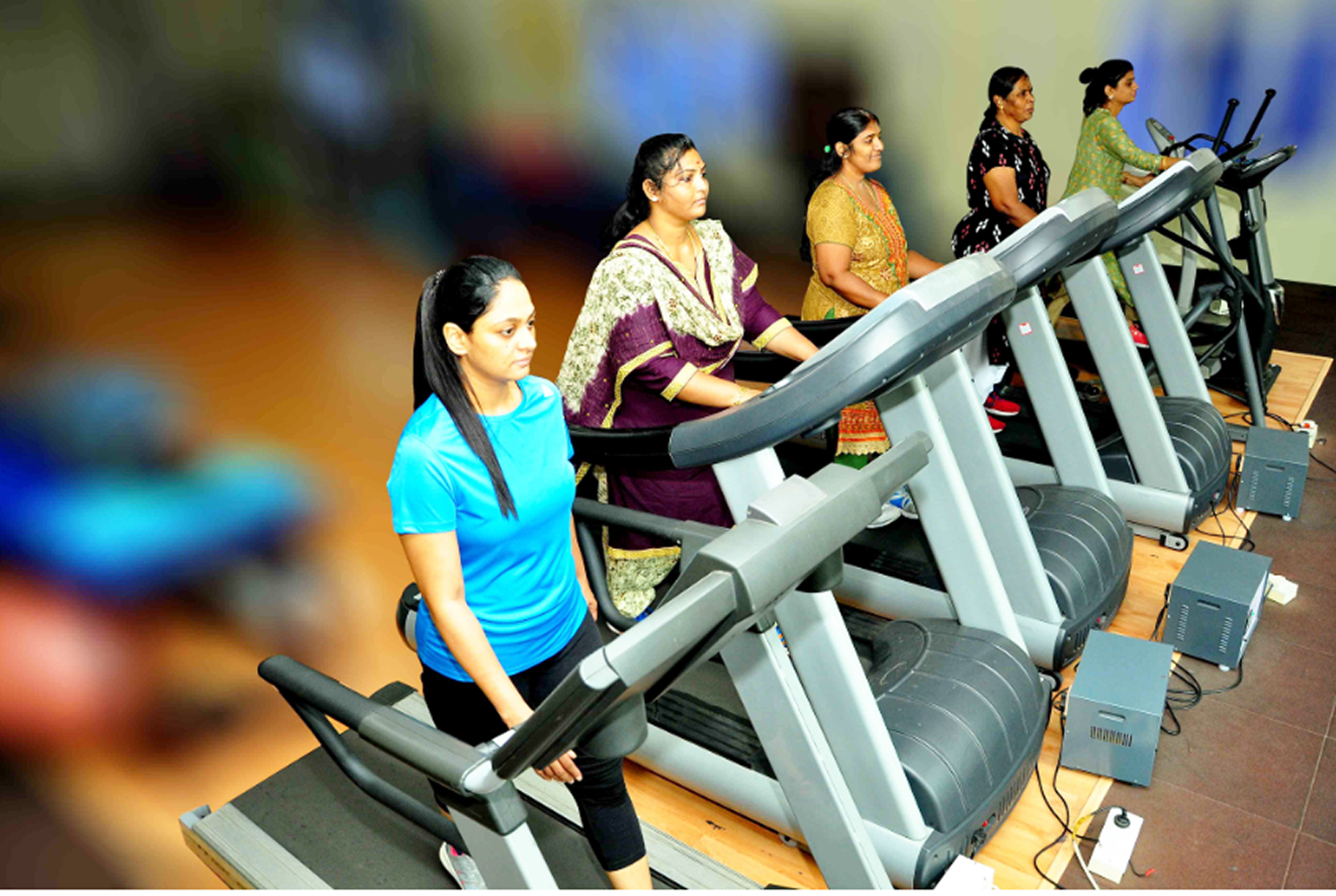
Weight gain, loss of confidence, depression and anxiety are the various issues that Indian women face owing to their lifestyle and scant importance given to their fitness and health. Women go through many stages of physical, emotional and social upheavals in their lives like menarchy, marriage and moving away from the parental home, pregnancy and child-birth and later menopause. All of these events put enormous pressure on women’s physical and mental health and it is the individual and their family’s duty to recognize the importance of their fitness and health.
Women’s Fitness Programs

SPARRC offers various individual and group fitness programs for women specifically. Move 2 Music is a Dance Therapy program where women participate enthusiastically shedding their inhibitions and gaining fitness and confidence. Yoga, Taichi, Breathing sessions are also ideally suited for women to improve on their stability and focus.
Call +91 965 965 0000 to learn more about the specific fitness programs for women available at SPARRC.
Stay Strong. Stay Confident. Stay Healthy.
Our women's fitness medicine program supports strength, emotional wellness, fitness, nutrition and sustainable health routines for women.
Women & Sports Medicine
Women Are Not a Niche in Sports Medicine
At a sports medicine clinic, the waiting room often tells a story.
A marathon runner recovering from an ACL tear. A domestic worker with chronic shoulder pain after years of lifting water buckets. A Bharatanatyam dancer battling recurrent stress fractures. A new mother with relentless back pain from carrying her child. A nurse dealing with plantar heel pain after years of standing through long shifts. A young corporate employee with neck pain, low vitamin D and early signs of poor bone health.
Different professions. Different lifestyles. Same reality.
Women’s bodies are constantly adapting to physical stress that often goes unseen and untreated.
Yet sports medicine continues to be framed around male athletes, while women are often treated as a niche category. In fact, women may be one of the most underrepresented majorities in musculoskeletal healthcare.
And the numbers tell their own story.
6 crore
people with osteoporosis by 2030
This estimate is commonly attributed to the International Osteoporosis Foundation and Indian consensus statements, often cited in collaboration with bodies like the Indian Council of Medical Research and Indian Menopause Society. It’s a projection based on India’s ageing population and existing prevalence trends.
1 in 3
Indian women over 50 at risk of osteoporosis-related fractures
This aligns with global and Indian data cited by the International Osteoporosis Foundation, which states that 1 in 3 women over 50 worldwide will experience osteoporotic fractures. Indian studies and position papers often apply this ratio due to similar or higher risk profiles, especially given lower baseline bone density and nutrition gaps.
70–90%
of Indians may be vitamin D deficient
This comes from multiple Indian studies and reviews, including research published in journals like the Indian Journal of Endocrinology and Metabolism and data referenced by Indian Council of Medical Research. The range varies by region, but urban populations, especially women, consistently show high deficiency rates.
Bone weakness, in many cases, starts much earlier than menopause.
Younger Women & Athletes
The risks can look different, but they are equally serious.
For younger women, especially athletes, the risks can look different but are equally serious.
Female athletes are significantly more vulnerable to ACL injuries than men in sports involving sudden pivots and jumps. Global sports medicine research suggests women may face ACL injury risks that are 2 to 8 times higher in sports like football, basketball and badminton due to differences in biomechanics, neuromuscular control and hormonal fluctuations.
A Quieter Issue
Relative Energy Deficiency in Sport (RED-S)
Then there’s a quieter issue clinicians are seeing more often: Relative Energy Deficiency in Sport (RED-S).
This happens when athletes underfuel their bodies while overtraining often driven by aesthetic pressures or misinformation around dieting.
The fallout can include
Sometimes what appears to be a knee injury starts with inadequate nutrition.
Invisible Physical Work
Not all women experiencing physical strain are athletes in the traditional sense.
But not all women experiencing physical strain are athletes in the traditional sense.
Think about women bent over agricultural fields for hours. Nurses lifting patients. Teachers stand all day. Factory workers performing repetitive tasks. Domestic workers carrying loads. Homemakers are doing years of unpaid labour without ergonomic support.
India’s Time Use Survey
According to India’s Time Use Survey, women spend nearly 5 hours a day on unpaid domestic work, compared to just over an hour for men. That physical labour rarely gets recognised as musculoskeletal stress but the body keeps count.
The result?
And many women continue working through it because stopping simply isn’t an option.
Pregnancy & Postpartum
Another major blind spot.
Then comes another major blind spot: pregnancy and postpartum recovery.
Pregnancy shifts posture, weakens core muscles and increases stress on joints and ligaments. Yet postpartum rehabilitation remains largely absent from mainstream conversations in India.
Many women silently navigate:
…and are told it’s just “part of motherhood.”
The Bigger Issue
Women’s pain is still normalised.
“You’re overreacting.”
“It happens with age.”
“Rest when you can.”
So they delay care. And that delay turns manageable injuries into chronic conditions.
The Future of Sports Medicine
Performance has a bigger definition.
The future of sports medicine has to expand its definition of performance.
Performance is a national athlete training for a medal.
It is also a mother carrying her toddler.
A nurse on a 12-hour shift.
A teacher standing all day.
A woman climbing four floors with groceries.
Better care means earlier screening, stronger nutrition awareness, postpartum rehabilitation, strength training and recognising invisible labour as real physical work.
Because women are not fragile.
They are often carrying far more than anyone acknowledges.
And sports medicine needs to stop treating them like an afterthought.


